Jazz is the most colorful and varied art form in the world and it was
born in one of the most colorful and varied cities, New Orleans. From
the seed first planted by slave dances held in Congo Square and nurtured
by early ensembles led by Buddy Belden and Joe "King" Oliver, jazz
began its long winding odyssey across America and around the world,
giving flower to a thousand different forms--swing, bebop, cool jazz,
jazz-rock fusion--and a thousand great musicians. Now, in The History of Jazz,
Ted Gioia tells the story of this music as it has never been told
before, in a book that brilliantly portrays the legendary jazz players,
the breakthrough styles, and the world in which it evolved.
Here are
the giants of jazz and the great moments of jazz history--Jelly Roll
Morton ("the world's greatest hot tune writer"), Louis Armstrong (whose
O-keh recordings of the mid-1920s still stand as the most significant
body of work that jazz has produced), Duke Ellington at the Cotton Club,
cool jazz greats such as Gerry Mulligan, Stan Getz, and Lester Young,
Charlie Parker's surgical precision of attack, Miles Davis's 1955
performance at the Newport Jazz Festival, Ornette Coleman's experiments
with atonality, Pat Metheny's visionary extension of jazz-rock fusion,
the contemporary sounds of Wynton Marsalis, and the post-modernists of
the Knitting Factory. Gioia provides the reader with lively portraits of
these and many other great musicians, intertwined with vibrant
commentary on the music they created. Gioia also evokes the many worlds
of jazz, taking the reader to the swamp lands of the Mississippi Delta,
the bawdy houses of New Orleans, the rent parties of Harlem, the
speakeasies of Chicago during the Jazz Age, the after hours spots of
corrupt Kansas city, the Cotton Club, the Savoy, and the other locales
where the history of jazz was made. And as he traces the spread of this
protean form, Gioia provides much insight into the social context in
which the music was born. He shows for instance how the development of
technology helped promote the growth of jazz--how ragtime blossomed
hand-in-hand with the spread of parlor and player pianos, and how jazz
rode the growing popularity of the record industry in the 1920s. We also
discover how bebop grew out of the racial unrest of the 1940s and '50s,
when black players, no longer content with being "entertainers," wanted
to be recognized as practitioners of a serious musical form. Jazz is a
chameleon art, delighting us with the ease and rapidity with which it
changes colors. Now, in Ted Gioia's The History of Jazz, we
have at last a book that captures all these colors on one glorious
palate. Knowledgeable, vibrant, and comprehensive, it is among the small
group of books that can truly be called classics of jazz literature.
A
phenomenally proficient trumpet player, Al Hirt was one of the most
successful instrumental recording artists of the 1960s. Perhaps modeling
his genial stage personality after Louis Armstrong, Hirt was a
tremendously popular performer, easily capturing the center of attention
with his massive 300-pound, 6-foot-2 frame (among his nicknames were
“Jumbo” and “The Round Mound of Sound”) but holding it with his joyful
spirit and jaw-dropping virtuosity.
Although
Hirt came out of New Orleans leading a Dixieland band, he never let
himself get stereotyped in that narrow genre. He was honest about his
choice of style, never calling what he played “jazz”: “I'm a pop
commercial musician,” he once said. “and I've got a successful format.
I'm not a jazz trumpet and never was a jazz trumpet.”
Hirt's
father bought him his first trumpet from a pawnshop, and by the time he
was in high school, he was sounding post time at the local race track.
Hirt was always very serious about perfecting his mastery of his
instrument, and he studied at the Cincinnati Conservatory for three
years in the early 1940s. After playing with Army bands during World War
Two, he worked with Tommy Dorsey, Ray McKinley, and Benny Goodman's big
bands--usually as first chair, but not a soloist--until he returned to
New Orleans and formed his own band in 1950.
For
most of the 1950s, he was comfortable staying close to home--musically
and professionally. Raising eight kids with his first wife probably had
something to do with it, but Hirt was always happy to have a strong
association with the music and lifestyle of New Orleans. He often
performed with clarinet player Pete Fountain, who achieved nearly the
same level of national fame, and the two remained close friends and
colleagues until Hirt's death. Hirt recorded a number of mainstream
Dixieland albums for Audio Fidelity and others during this period.
In
1960, Hirt's group, the Dixieland Six, played Las Vegas and was spotted
by Dinah Shore, who booked them onto her television variety show.
Television and Hirt took to each other, and RCA quickly signed him and
began promoting him as a major artist. To get and keep a national
audience, Hirt had to loosen his ties to Dixieland. Virtually none of
his RCA albums have a strong Dixieland flavor, most of them featuring
large studio ensembles and arrangements by veterans like Marty Paich,
Billy May, and Marty Gold. His albums “Honey in the Horn,” and “Cotton
Candy,” were both gold records, and he was named “Top Instrumentalist”
by Billboard magazine in 1965. His recording of “Java,” won him a
Grammy.
Hirt
never turned his back on his roots, though, and at the same time he was
coming to fame, he opened his own night club in the French Quarter and
appeared there regularly. Although he toured steadily well into the
1980s, often in pops concerts with symphony orchestras, he tried to work
his schedules to bring him back home quickly. His 1965 album with
Arthur Fiedler and the Boston Pops was among his best-selling records,
and Hirt enjoyed playing classical showpieces as well as popular
numbers.
Hirt's
weight and lifestyle eventually took its toll on his body, and in later
years, he had to perform in a wheelchair. He closed his club in 1983,
fed up with the deterioration of the French Quarter, but he continued to
play there, mostly at Fountain's club, until a few months before his
death in 1999.
Al
Hirt recorded more than 50 albums in his career, and played for
millions of people around the world including Pope John Paul II and 8
U.S. Presidents. He earned 4 gold albums and 1 platinum, and a Lifetime
Achievement Award from the Charlie “Bird” Parker Memorial Foundation.
He is a legend in his native New Orleans, where there is a live sized statue of him in the French Quarter.
Source: James Nadal
///////
Un
trompetista fenomenal, Al Hirt fue uno de los artistas instrumentales
más exitosos de la década de 1960. Tal vez modelando su genial
personalidad escénica después de Louis Armstrong, Hirt fue un artista
tremendamente popular, capturando fácilmente el centro de atención con
su enorme marco de 300 libras y 2 pies (entre sus apodos se encontraban
"Jumbo" y "The Round Mound of Sound"), pero sosteniéndolo con su
espíritu alegre y su virtuosismo asombroso.
Aunque
Hirt salió de Nueva Orleans liderando una banda de Dixieland, nunca se
dejó estereotipar por ese género tan estrecho. Fue honesto en su
elección de estilo, sin llamar nunca "jazz" a lo que tocaba: "Soy un
músico comercial de pop", dijo una vez. "y tengo un formato exitoso. No
soy una trompeta de jazz y nunca fui una trompeta de jazz".
El
padre de Hirt le compró su primera trompeta en una casa de empeño, y
para cuando estaba en la escuela secundaria, ya estaba sonando en el
hipódromo local. Hirt siempre se tomó muy en serio el perfeccionamiento
de su instrumento, y estudió en el Conservatorio de Cincinnati durante
tres años a principios de la década de 1940. Después de tocar con bandas
del Army durante la Segunda Guerra Mundial, trabajó con las grandes
bandas de Tommy Dorsey, Ray McKinley y Benny Goodman, generalmente como
primer presidente, pero no como solista, hasta que regresó a Nueva
Orleáns y formó su propia banda en 1950.
Durante
la mayor parte de la década de 1950, se sintió cómodo estando cerca de
casa, musical y profesionalmente. Criar ocho hijos con su primera esposa
probablemente tuvo algo que ver con ello, pero Hirt siempre estuvo
feliz de tener una fuerte asociación con la música y el estilo de vida
de Nueva Orleáns. A menudo tocaba con el clarinetista Pete Fountain, que
alcanzó casi el mismo nivel de fama nacional, y los dos permanecieron
como amigos y colegas hasta la muerte de Hirt. Hirt grabó varios álbumes
de Dixieland para Audio Fidelity y otros durante este periodo.
En
1960, el grupo de Hirt, los Seis de Dixieland, jugó en Las Vegas y fue
visto por Dinah Shore, que lo contrató en su programa de variedades de
televisión. La televisión y Hirt se llevaron bien, y la RCA rápidamente
lo contrató y comenzó a promocionarlo como un artista importante. Para
conseguir y mantener una audiencia nacional, Hirt tuvo que aflojar sus
lazos con Dixieland. Prácticamente ninguno de sus álbumes de RCA tiene
un fuerte sabor a Dixieland, la mayoría de ellos con grandes conjuntos
de estudio y arreglos de veteranos como Marty Paich, Billy May y Marty
Gold. Sus álbumes "Honey in the Horn" y "Cotton Candy" fueron discos de
oro, y fue nombrado "Top Instrumentalist" por la revista Billboard en
1965. Su grabación de "Java" le valió un Grammy.
Sin
embargo, Hirt nunca le dio la espalda a sus raíces, y al mismo tiempo
que llegaba a la fama, abrió su propio club nocturno en el Barrio
Francés y apareció allí regularmente. Aunque hizo giras constantes hasta
bien entrada la década de 1980, a menudo en conciertos de música pop
con orquestas sinfónicas, trató de trabajar sus horarios para traerlo de
vuelta a casa rápidamente. Su álbum de 1965 con Arthur Fiedler y los
Boston Pops fue uno de sus discos más vendidos, y Hirt disfrutó tocando
obras de teatro clásicas así como números populares.
El
peso y el estilo de vida de Hirt finalmente afectaron su cuerpo, y en
años posteriores, tuvo que actuar en una silla de ruedas. Cerró su club
en 1983, harto del deterioro del French Quarter, pero siguió tocando
allí, sobre todo en el club de Fountain, hasta unos meses antes de su
muerte en 1999.
Al
Hirt grabó más de 50 álbumes en su carrera, y tocó para millones de
personas en todo el mundo, incluyendo al Papa Juan Pablo II y a 8
presidentes de los Estados Unidos. Obtuvo 4 discos de oro y 1 de
platino, y un premio a la Trayectoria de la Fundación Charlie "Bird"
Parker Memorial.
Es una leyenda en su Nueva Orleans natal, donde hay una estatua de él en el Barrio Francés.
Formed in in 2009, Tuba Skinny has
steadily evolved from a loose collection of street musicians into a
solid ensemble dedicated to bringing the traditional New Orleans sound
to audiences around the world. Drawing on a wide range of musical
influences—from spirituals to Depression-era blues, from ragtime to
traditional jazz—their sound evokes the rich musical heritage of their
New Orleans home. The band has gained a loyal following through their
distinctive sound, their commitment to reviving long-lost songs, and
their barnstorming live performances.
///////
Fundada en 2009, Tuba Skinny ha evolucionado constantemente de una
colección suelta de músicos callejeros a un sólido conjunto dedicado a
llevar el sonido tradicional de Nueva Orleans a audiencias
de todo el mundo. Basándose en una amplia gama de influencias musicales
-desde espirituales hasta blues de la época de la Depresión, desde
ragtime hasta jazz tradicional-, su sonido evoca la rica herencia
musical de su hogar en Nueva Orleáns. La banda ha ganado un seguimiento
leal a través de su sonido distintivo, su compromiso de revivir
canciones perdidas hace mucho tiempo, y sus actuaciones en vivo.
Biography by Cub Koda In the 1930s, at the height of the Depression, rural Americans desperate for a laugh tuned in their radios to enjoy the cornball musical antics of the Hoosier Hot Shots. Their odd-sounding blend of a slide whistle and clarinet as the two lead instruments, the solid rhythm of the washboard, and their bizarre song lyrics made them the top novelty act of their day and the true precursor to the latter-day success of Spike Jones & His City Slickers. In the passage of some 50 to 60 years since their heyday and in the current climate of digital samplers, it becomes hard to imagine just how weird this four-piece combo sounded to the average listener. As clarinetist bandleader Gabe Ward put it, "People started to laugh as soon as we started playing. We had a funny sound with the whistle and the clarinet. The way Hezzie played it, it was funny." The Hezzie that Ward refers to was one Paul "Hezzie" Trietsch, the washboard-playing, slide whistle-blowing heart of the group. Ward had met him and his older brother Ken in their teenage years. All three had music in their blood and by the late '20s, they were playing together in an outfit called Ezra Buzzington's Rube Band. Buzzington's outfit worked the vaudeville circuit, its main claim to fame being its huge assortment of freak musical instruments. It was here that the trio stared honing their chops, with Ken becoming equally adept on guitar and banjo, Ward's clarinet style veering from swing to sweet to silly, and Hezzie coming into his own playing washboard, slide whistle, and a wild assortment of whistles, bells, and horns.
They stayed with Buzzington until he disbanded the group in 1929, the three vowing to stay in touch, and playing together in various on and off situations. In 1932, the Trietsch Brothers and Ward -- their stage moniker at the time -- were broadcasting over WOWO in Fort Wayne, IN. Doing a charity broadcast to help Ohio River Valley flood victims, they quickly found and developed their style doing novelty renditions of good-time songs, playing one after another during the course of the radio-thon. They picked up a 15-minute sustaining program on the station for no pay but with the chance to promote their own live appearances over the airwaves. They soon came to even wider prominence via their radio appearances on the National Barn Dance, broadcast over powerful station WLS in Chicago. The show was the first of its type to be broadcast and reach a wide audience, predating the subsequent success of Nashville's Grand Ole Opry and counting a young Gene Autry, Lulubelle & Scotty, and Red Foley among its many stars.
The show became a radio staple, broadcasting every Saturday night across the country for over 35 years. The trio -- under their new name, the Hoosier Hot Shots -- were an immediate hit, considering it an honor to be hooked up with the most prestigious show in country music. But the group just as quickly moved over to a regular guest spot on the Uncle Ezra Pinex Cough Syrup program, and when Uncle Ezra secured a national spot with NBC, he took the Hot Shots with him, and the group's national success was quickly assured.
They started making records around this time, and the Hot Shots couldn't have asked for a more sympathetic producer on their sessions than Art Satherly. Satherly, a distinguished Englishman, was in charge of Columbia Records' (at that time ARC) country and blues A&R division. As Gabe Ward put it, "What Art Satherly wanted on record was out visualness; he was trying to get that through. And he succeeded with us, because we were about the only people who could make people laugh after only four bars of music!" Satherly, for his part, would strip down to his shirt, put a bath towel around his neck, and go into the studio and dance to illustrate the tempo he wanted the Hot Shots to record at. The formula -- with Gabe calling out, "Are you ready, Hezzie?" at the start of each tune -- was a wildly successful one, with the band's records fitting comfortably on jukeboxes around the country in the "novelty dance" category. Among their hits were "I Like Bananas Because They Have No Bones," "The Coat and Pants Do All the Work," and "From the Indies to the Andies in His Undies," exactly the type of tunes that fitted the group like a glove. "We were tops in the novelty field," Ward would later reminisce, "all because of Art Satherly. He had the nerve to put them on the jukeboxes, even though they weren't always the top tunes. We'd do it for Art Satherly, with a beat for the jukeboxes." What Ward also fails to mention, however, is the group's tireless promotion of those records, making in-store appearances at all the Sears and Roebuck outlets nationwide when their 78s started appearing on the company's budget label, Perfect.
By the late '30s the Hot Shots started making movie appearances, debuting with a turn in In Old Monterey in 1939. The success of this and a couple others led the group to give up their sustaining radio spot with Uncle Ezra, relocating to the West Coast after World War II. Signing a movie deal with Columbia Pictures, the Hot Shots would go on to appear in 22 films into the early '50s. With the advent of changing tastes and the rise of television, the boys' star fell into eclipse somewhat, although they found steady work on the Nevada gambling casino circuit. The group soldiered on into the '70s, when Paul "Hezzie" Trietsch's death broke up the original group. Although nowhere near as wild as Spike Jones, nor possessing the "thinking man's hillbillies" personas of Homer & Jethro, it is impossible to think of either of those two acts existing -- much less prospering and finding an audience -- without the groundbreaking efforts of the Hoosier Hot Shots.
///////
Biografía de Cub Koda En los años 30, en el punto álgido de la Depresión, los americanos rurales desesperados por una risa sintonizada en sus radios para disfrutar de las payasadas musicales de los Hoosier Hot Shots. Su extraña mezcla de un silbato de diapositivas y un clarinete como instrumentos principales, el sólido ritmo de la tabla de lavar y las extrañas letras de sus canciones los convirtieron en el acto más novedoso de su época y en el verdadero precursor del éxito de los últimos tiempos de Spike Jones & His City Slickers. En el paso de unos 50 o 60 años desde su apogeo y en el clima actual de los samplers digitales, se hace difícil imaginar lo raro que sonaba este combo de cuatro piezas para el oyente medio. Como dijo el director de la banda de clarinetes Gabe Ward: "La gente empezó a reírse en cuanto empezamos a tocar. Teníamos un sonido divertido con el silbato y el clarinete. La forma en que Hezzie lo tocaba era divertida". El Hezzie al que se refiere Ward era un Paul "Hezzie" Trietsch, el corazón del grupo que tocaba la tabla de lavar y tocaba el silbato de diapositivas. Ward lo había conocido a él y a su hermano mayor Ken en su adolescencia. Los tres llevaban la música en la sangre y a finales de los años 20, tocaban juntos en un grupo llamado Ezra Buzzington's Rube Band. El grupo de Buzzington trabajaba en el circuito de vodevil, y su principal reclamo a la fama era su enorme surtido de instrumentos musicales raros. Fue aquí donde el trío comenzó a afinar sus habilidades, con Ken convirtiéndose en un experto en guitarra y banjo, el estilo de clarinete de Ward cambiando de swing a dulce y a tonto, y Hezzie entrando en el suyo propio tocando la tabla de lavar, el silbato deslizante, y un salvaje surtido de silbatos, campanas y cuernos.
Permanecieron con Buzzington hasta que él disolvió el grupo en 1929, los tres jurando mantenerse en contacto, y tocando juntos en varias situaciones de dentro y fuera. En 1932, los hermanos Trietsch y Ward - su apodo artístico en ese momento - estaban transmitiendo por WOWO en Fort Wayne, IN. Realizando una emisión benéfica para ayudar a las víctimas de las inundaciones del valle del río Ohio, encontraron y desarrollaron rápidamente su estilo haciendo novedosas interpretaciones de canciones para pasar el rato, tocando una tras otra durante el transcurso de la radio-tonificación. Escogieron un programa de 15 minutos de duración en la emisora sin cobrar, pero con la posibilidad de promocionar sus propias apariciones en directo a través de las ondas. Pronto alcanzaron una mayor prominencia a través de sus apariciones en el National Barn Dance, transmitido por la poderosa estación WLS en Chicago. El espectáculo fue el primero de su tipo en ser transmitido y llegar a una amplia audiencia, antes del éxito posterior del Grand Ole Opry de Nashville y contando con un joven Gene Autry, Lulubelle & Scotty, y Red Foley entre sus muchas estrellas.
El programa se convirtió en un elemento básico de la radio, transmitiéndose todos los sábados por la noche en todo el país durante más de 35 años. El trío, bajo su nuevo nombre, los Hoosier Hot Shots, fue un éxito inmediato, considerando un honor estar conectado con el programa más prestigioso de la música country. Pero el grupo también se mudó rápidamente a un lugar de invitado regular en el programa de jarabe para la tos del tío Ezra Pinex, y cuando el tío Ezra se aseguró un lugar nacional en la NBC, se llevó los Hot Shots con él, y el éxito nacional del grupo se aseguró rápidamente.
Empezaron a grabar discos en esta época, y los Hot Shots no podían haber pedido un productor más simpático en sus sesiones que Art Satherly. Satherly, un distinguido inglés, estaba a cargo de la división de country y blues A&R de Columbia Records (en ese momento ARC). Como dijo Gabe Ward, "Lo que Art Satherly quería en la grabación era nuestra visualidad; estaba tratando de conseguir eso. Y tuvo éxito con nosotros, porque éramos los únicos que podíamos hacer reír a la gente después de sólo cuatro compases de música!" Satherly, por su parte, se desnudaba hasta la camisa, se ponía una toalla de baño alrededor del cuello, y entraba en el estudio y bailaba para ilustrar el tempo en el que quería que se grabaran los Hot Shots. La fórmula, con Gabe gritando "¿Estás listo, Hezzie?" al principio de cada canción, fue un gran éxito, con los discos de la banda cabiendo cómodamente en las rocolas de todo el país en la categoría de "baile novedoso". Entre sus éxitos estaban "I Like Bananas Because They Have No Bones", "The Coat and Pants Do All the Work" y "From the Indies to the Andies in His Undies", exactamente el tipo de melodías que encajaban en el grupo como un guante. "Éramos los mejores en el campo de las novedades", recordaría Ward más tarde, "todo gracias a Art Satherly". Tuvo el descaro de ponerlas en las rocolas, aunque no siempre eran las mejores melodías. Lo hacíamos por Art Satherly, con un ritmo para las gramolas." Lo que Ward tampoco menciona, sin embargo, es la incansable promoción del grupo de esos discos, haciendo apariciones en tiendas en todos los puntos de venta de Sears y Roebuck a nivel nacional cuando sus 78 empezaron a aparecer en el sello de presupuesto de la compañía, Perfect.
A finales de los años 30, los Hot Shots empezaron a hacer apariciones en películas, debutando con un giro en In Old Monterey en 1939. El éxito de esta y otras dos llevó al grupo a renunciar a su anuncio de radio de apoyo con el tío Ezra, trasladándose a la costa oeste después de la Segunda Guerra Mundial. Firmando un contrato con Columbia Pictures, los Hot Shots aparecerían en 22 películas a principios de los 50. Con la llegada del cambio de gustos y el auge de la televisión, la estrella de los chicos cayó en un cierto eclipse, aunque encontraron trabajo estable en el circuito de casinos de Nevada. El grupo siguió adelante en los años 70, cuando la muerte de Paul "Hezzie" Trietsch rompió el grupo original. Aunque no son tan salvajes como Spike Jones, ni poseen los personajes de Homer & Jethro, es imposible pensar en ninguno de los dos actos que existen, y mucho menos en prosperar y encontrar un público, sin los esfuerzos pioneros de los Hoosier Hot Shots. https://www.allmusic.com/artist/hoosier-hot-shots-mn0000219445/biography
Formed in in 2009, Tuba Skinny has steadily evolved from a loose collection of street musicians into a solid ensemble dedicated to bringing the traditional New Orleans sound to audiences around the world. Drawing on a wide range of musical influences—from spirituals to Depression-era blues, from ragtime to traditional jazz—their sound evokes the rich musical heritage of their New Orleans home. The band has gained a loyal following through their distinctive sound, their commitment to reviving long-lost songs, and their barnstorming live performances.
///////
Fundada en 2009, Tuba Skinny ha evolucionado constantemente de una colección suelta de músicos callejeros a un sólido conjunto dedicado a llevar el sonido tradicional de Nueva Orleans a audiencias de todo el mundo. Basándose en una amplia gama de influencias musicales -desde espirituales hasta blues de la época de la Depresión, desde ragtime hasta jazz tradicional-, su sonido evoca la rica herencia musical de su hogar en Nueva Orleáns. La banda ha ganado un seguimiento leal a través de su sonido distintivo, su compromiso de revivir canciones perdidas hace mucho tiempo, y sus actuaciones en vivo.
A fine if now forgotten dixieland band, the Riverboat Five played no-nonsense New Orleans jazz during the second half of the 1950's. Founded and led by clarinetist Ed Reed, the original group consisted of cornetist Ted Butterman, trombonist Wray Thomas, pianist Keller Merck, banjoist Dargan Fitch, tuba player Ed Tedder (who doubled on tenor), and drummer Jim Lunsford. Originally based in Atlanta, the band developed their group sound while playing for three years in Atlanta at a garage that was converted into a nightclub. After working in the Southwest, they.gained some fame in Las Vegas where they were signed to play eight weeks a year for the Dunes Hotel during 1957-61. The Riverboat Five (which was always a septet) also caught on well enough in New York to become a popular attraction at Bourbon Street. They recorded six Lps for Mercury during 1958-61 (none of which have been reissued on CD). While the first three were cut in Chicago with the group's original lineup the fourth and fifth were made in Los Angeles with such notable names as tenorsaxophonist Eddie Miller, guitarist Nappy Lamare, either Ray Bauduc or Nick Fatool on drums, trombonist Bob Havens and trumpeter Dick Cathcart. The group's final effort was cut with an expanded lineup live in New Orleans in 1961. Throughout their career, the Riverboat Five mostly stuck to dixieland warhorses (with occasional exceptions) but Hall's arrangements and the musicians' general enthusiasm made their renditions sound fresh and lively.
Una buena, aunque ya olvidada, banda de dixieland, los Riverboat Five tocaron jazz de Nueva Orleans durante la segunda mitad de los 50. Fundado y dirigido por el clarinetista Ed Reed, el grupo original estaba formado por el cornetista Ted Butterman, el trombonista Wray Thomas, el pianista Keller Merck, el banquero Dargan Fitch, el tubista Ed Tedder (que tocaba el tenor) y el baterista Jim Lunsford. Originalmente con base en Atlanta, la banda desarrolló su sonido de grupo mientras tocaba durante tres años en Atlanta en un garaje que se convirtió en un club nocturno. Después de trabajar en el suroeste, ganaron algo de fama en Las Vegas, donde fueron contratados para tocar ocho semanas al año en el Hotel Dunes durante 1957-61. El Riverboat Five (que siempre fue un septeto) también se impuso lo suficiente en Nueva York como para convertirse en una atracción popular en Bourbon Street. Grabaron seis Lps para Mercury durante 1958-61 (ninguno de los cuales ha sido reeditado en CD). Mientras que los tres primeros se grabaron en Chicago con la formación original del grupo, el cuarto y el quinto se hicieron en Los Ángeles con nombres tan notables como el tenorsaxofonista Eddie Miller, el guitarrista Nappy Lamare, Ray Bauduc o Nick Fatool en la batería, el trombonista Bob Havens y el trompetista Dick Cathcart. El último esfuerzo del grupo fue cortado con una alineación ampliada en vivo en Nueva Orleans en 1961. A lo largo de su carrera, los Riverboat Five se limitaron a los caballos de guerra de dixieland (con excepciones ocasionales), pero los arreglos de Hall y el entusiasmo general de los músicos hicieron que sus interpretaciones sonaran frescas y animadas.
por Scott Yanow
https://www.allmusic.com/artist/riverboat-five-mn0001470419
Lillian Hardin Armstrong (née Hardin; February 3, 1898 – August 27, 1971) was an American jazz pianist, composer, arranger, singer, and bandleader. She was the second wife of Louis Armstrong, with whom she collaborated on many recordings in the 1920s. Her compositions include "Struttin' with Some Barbecue", "Don't Jive Me", "Two Deuces", "Knee Drops", "Doin' the Suzie-Q", "Just for a Thrill" (which was a hit when revived by Ray Charles in 1959), "Clip Joint", and "Bad Boy" (a hit for Ringo Starr in 1978). Armstrong was inducted into the Memphis Music Hall of Fame in 2014.
Background Lil's grandmother, Priscilla Martin, was a former slave from near Oxford, Mississippi. Martin had a son and three daughters, one of whom was Dempsey, Lil's mother. Priscilla Martin moved her family to Memphis to escape from her husband, a trek the family made by mule-drawn wagon. Dempsey married Will Harden, and Lillian Hardin was born on February 3, 1898. She grew up in a household with her grandmother. Will died when Lil was seven. Dempsey later remarried to John Miller. During her early years, Hardin was taught hymns, spirituals, and classical music on the piano. She was drawn to popular music and later blues.
Early education and mentors Hardin first received piano instruction from her third-grade teacher, Violet White. Her mother then enrolled her in Mrs. Hook's School of Music. At Fisk University, a college for African Americans in Nashville, she received more advanced training, and earning a diploma from Fisk, returned to Memphis in 1917. In August 1918, she moved to Chicago with her mother and stepfather. By then she had become a proficient sight-reader, a skill that helped her gain a job as a sheet music demonstrator at Jones Music Store. The store paid Hardin $3 a week (US$58 in 2022 dollars), but bandleader Lawrence Duhé offered $22.50 (US$438 in 2022 dollars). Knowing that her mother would disapprove of her working in a cabaret, she made it known that her new job was playing for a dancing school. As observed by Thomas Brothers, the discrepancies between her education and that of Duhé's band members were apparent; when she asked what key the New Orleanians were going to play in, they remarked, "We don't know what key. When you hear two knocks start playing." Three weeks later the band moved to a better booking at the De Luxe Café, where the entertainers included Florence Mills and Cora Green. From there, the band moved up to Dreamland. Here the principal entertainers were Alberta Hunter and Ollie Powers. When King Oliver's Creole Jazz Band replaced Duhé's group at Dreamland, Oliver asked Hardin to stay with him. She was with Oliver at Dreamland in 1921 when an offer came for the orchestra to play a six-month engagement at the Pergola Ballroom in San Francisco. At the end of that booking Hardin returned to Chicago while the rest of the Oliver band went to Los Angeles. She later studied at the New York College of Music, where she earned a post-graduate diploma in 1929.
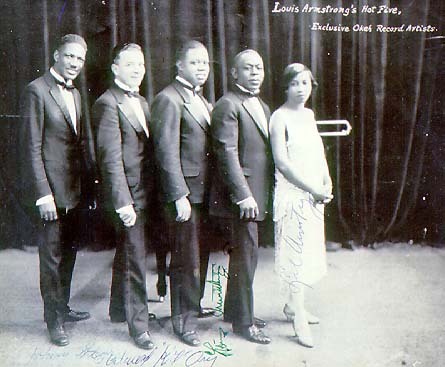
Marriages and divorces In Chicago, Hardin returned to work at Dreamland as a pianist in an orchestra for Mae Brady, a violinist and vaudeville stalwart. While there, she fell for Jimmie Johnson, a young singer from Washington, D.C., whom she married on August 22, 1922. The marriage was short-lived, ending in divorce. The Oliver band returned from California and opened at the Royal Gardens with Bertha Gonsoulin at the piano but soon found itself back at Dreamland with Hardin at the piano. King Oliver's band was enjoying enormous success at Dreamland when he sent for Louis Armstrong to join as second cornetist. Armstrong was beginning to make a name for himself in New Orleans and regarded Oliver ("Papa Joe") as his mentor. At first, Hardin was unimpressed, remembering that she "was very disgusted" by Louis, who arrived in Chicago wearing clothes and a hair style that she deemed to be "too country" for Chicago, but she worked to "take the country out of him", and a romance developed (to the surprise of other band members, some of whom had been trying to woo her for some time with no success). They would visit cabarets and after-hour spots after their job at Lincoln Gardens, but their relationship was solidified after Armstrong's mother's intervention in 1923, when she visited Armstrong in Chicago. She and Armstrong needed to be divorced from their previous relationships (Lil Hardin to Jimmie Johnson, Louis Armstrong to Daisy Armstrong) and "claimed desertion" from said relationships to annul the marriages. Hardin and Armstrong were married on February 5, 1924, and honeymooned/toured with the Oliver band in Biglerville, Pennsylvania. The Defender noted that Hardin was dressed in a "Parisian gown of white crepe elaborately beaded in rhinestones and silver beads." Hardin took Armstrong shopping and taught him how to dress more fashionably. She got rid of his bangs and began working to foster his career. In addition to updating his appearance, Hardin assisted Armstrong in learning classical music with the help of a German teacher in Chicago. She felt he was wasting his talent in a secondary role. Armstrong was happy to be playing next to his idol, but Hardin at first persuaded him to manage his own money and assert himself on the bandstand and during recording sessions; eventually, she convinced him to leave Oliver and go out on his own. Armstrong resigned from Oliver's band and in September 1924 accepted a job with bandleader Fletcher Henderson in New York City. Hardin stayed in Chicago, first with Oliver, then leading a band of her own. When Hardin's band got a job at the Dreamland Café in Chicago she prepared for Armstrong's return to Chicago by having a huge banner that read "The World's Greatest Trumpet Player". Richard M. Jones convinced Okeh Records to make a series of sessions under his name: the Armstrong "Hot Five" recordings. With Hardin at the piano, Kid Ory on trombone, Johnny Dodds on clarinet, and Johnny St. Cyr on banjo, this group rehearsed at Armstrong and Hardin's residence on Chicago's East 41st Street and held its first session on November 15, 1925. In the late 1920s, Hardin and Armstrong grew apart due to class differences and money issues. He formed a new Hot Five with Earl Hines on piano. Hardin reformed her own band with Freddie Keppard, whom she considered second only to Armstrong. Hardin and Armstrong separated in 1931 when he had a liaison with Alpha Smith, who threatened to sue Armstrong for breach of promise, so he begged Hardin not to grant him a divorce. They finally divorced in 1938.
Later years In the 1930s, sometimes billing herself as "Mrs. Louis Armstrong", Hardin led an "All Girl Orchestra", a mixed-sex big band which broadcast nationally over the NBC radio network. In the same decade she recorded for Decca as a swing vocalist and performed as piano accompanist for other singers. She also performed with Red Allen.
Solo work In the late 1940s and early 1950s, Hardin worked mostly as a soloist, singing and playing piano. In the late 1940s, she decided to leave the music business and become a tailor, so she took a course in tailoring. Her graduation project was to make a tuxedo for Armstrong. Hardin returned to Chicago and the house on East 41st Street. She made a trip to Europe and had a brief love affair in France, but mostly she worked around Chicago, often with fellow Chicagoans. Collaborators included Red Saunders, Joe Williams, Oscar Brown Jr., and Little Brother Montgomery. In the 1950s, Hardin recorded a biographical narrative for Bill Grauer at Riverside Records that was issued in LP form. She would again appear on that label in 1961, participating in its project Chicago: The Living Legends as accompanist for Alberta Hunter and leader of her own hastily assembled big band. The Riverside recordings led to her inclusion in a 1961 NBC network special, Chicago and All That Jazz, and a follow-up album released by Verve. In 1962, she began writing her autobiography with Chris Albertson, but she changed her mind when she realized the book would include experiences that might discomfit Louis Armstrong, so the project was delayed until his death. She died before finishing the book.
Death When Louis Armstrong died in 1971, she traveled to New York for the funeral and rode in the family car. Returning to Chicago, she felt that work on her autobiography could continue, but the following month, performing at a televised memorial concert for Armstrong, she collapsed at the piano and died from a heart attack on the way to the hospital. After her funeral, her letters and the unfinished manuscript of her autobiography disappeared from her house. She was interred at Lincoln Cemetery in Blue Island, Illinois. In 2004, the Chicago Park District renamed a community park in her honor.
Legacy Hardin's song "Bad Boy" was recorded by Ringo Starr in 1978 and became an international pop hit. Armstrong's composition "Oriental Swing" was sampled by electro swing musician Parov Stelar to create the 2012 song "Booty Swing". The song gained notoriety when it was used in a 2013 Chevrolet commercial. https://en.wikipedia.org/wiki/Lil_Hardin_Armstrong
Lil Harding [1898-1971] fue la primera mujer extraordinaria en el jazz en la década de los años 20, dándose a conocer en la banda de King Oliver.
Pianista destacada en una época cuando los instrumentos estaban dominados por hombres, cantante, arreglista, directora de bandas y gran compositora. Entre sus muchas composiciones están los famosos Struttin´ With Some Barbecue, Don´t Jive Me, Just For A Thrill (revivida por Ray Charles en 1959) y Bad Boy (reinterpretada por Ringo Starr en 1978 con mucho éxito).
Lil fue también la segunda esposa de Louis Arrmstrong, con quien dejó muchas grabaciones hechas en los años 20, Lil Harding toca piano en el conjunto de King Oliver en una de sus primeras grabaciones; en ese grupo estaba también el protegido de Oliver, Louis Armstrong.
Bio:
Nació en Memphis, Tennessee (EE UU) y tuvo una formación clásica en piano al asistir desde pequeña a una escuela de música, y que continuó en la Fisk University.
En 1918, Lil se traslada junto a su madre y su padrastro a Chicago y comienza a trabajar en una tienda de música llamada Jones Music Store. Su propietaria, Jennie Jones, también era agente de música y, conociendo las dotes musicales de Lily, la animó para que aceptase tocar en alguna banda de música swing o jazz. Sin embargo, la madre de Lil no veía con buenos ojos esa música a la que calificaba de "pecado".
Lillian, para poder tocar en la banda del clarinetista Lawrence Duhe, engañó a su madre diciéndola que tocaba en una escuela de danza. De allí, la banda fue cogiendo fama en los clubes de Chicago hasta que en 1921 se asentó en uno de los locales nocturnos más importantes de la ciudad: "The Dreamland". Fue allí donde conoció a Joe King Oliver y éste la ofrece el puesto de pianista en su grupo Creole Jazz Band. Hardin toca con ellos durante un tiempo limitado tanto en Chicago como el San Francisco, pero cuando la banda se traslada a Los Ángeles, Lil decide volver a su ciudad.
Lillian Hardin vuelve a trabajar en el local "Dreamland" como pianista, y allí conocería a Jimmie Johnson, un cantante más joven que ella del que se enamoraría. Se casaron en 1922, pero se separaran poco tiempo después. Es entonces cuando la Creole Jazz Band regresa a Chicago y Joe King Oliver la vuelve a ofrecer el puesto de pianista; ella acepta.
En 1922, Oliver invita a Chicago a Louis Armstrong para unirse a su banda como segundo cornetista, ya que éste ya empieza a tener fama como trompetista. Es entonces cuando al Creole Jazz Band alcanza un gran éxito tanto artístico como económico y Armstrong se convierte en un músico famosísimo. Lillian Hardin se enamora de Louis al que, en un principio, consideraba un pueblerino. Este enamoramiento causa sorpresa entre los integrantes de la banda ya que algunos habían intentado, sin éxito, conquistarla. Lil ayuda a Louis a poder divorciarse de su primera esposa y ambos se casan en 1924.
Lillian Hardin, admirando el talento de su segundo esposo, convence a éste de abandonar amistosamente a Oliver para poder alcanzar mayores metas artísticas. Armstrong se traslada a Nueva York en 1924 pero Hardin continúa trabajando para Joe King Oliver, hasta que decide formar su propia banda y en 1925 vuelve a asentarse por tercera vez en el club "Dreamland".
Ese mismo año, regresa Armstrong, y el matrimonio junto a Kid Orly (trombón), Johnny Dodds (clarinete) y Johnyy St. Cyr (banggio) forman la banda Hot Five (y los Hot Seven junto a Earl Hines), con la que obtendrían grandes éxitos tanto artísticos como económicos pues realizaron numerosas grabaciones.
Pero a partir de 1928, el matrimonio se empezó a separarse, entre otras causas debido a las infidelidades de Louis. Earl Hines ocupa el piano y Lily forma otra banda propia. En 1931 se divorcian.
Lillian Hardin siguió trabajando como pianista, pero también como cantante. Grabó varios temas para Decca Records y trabajó con otros artistas como Ray Charles y Ringo Starr. Pero poco a poco empieza a alejarse del mundo de la música, al que tan sólo vuelve en ocasiones puntuales.
En 1962, escribió su autobiografía en colaboración con Chris Alberson.
Muere en Chicago en 1971 de un colapso mientras tocaba el piano en un concierto televisado en homenaje de Louis Armstrong, que había fallecido un mes antes. http://en.wikipedia.org/wiki/Lil_Hardin_Armstrong
Clarinetist Ken Peplowski and guitarist Howard Alden have a rare musical E.S.P. that enables them to weave intricate lines around each other as they soar through a great mix of overlooked standards and older jazz works on this live date. Peplowski's lyricism is stimulated by Alden's seemingly endless variations on "Blue Room," and the duo transforms "In the Dark" from a piano solo into an impressionist suite for their two instruments. But it is the spirited version of "Chasin' the Bird," complete with Peplowski's whimsical pun-filled introduction, that displays the depth of their playing. There is no loss of momentum when Peplowski switches to tenor sax. His vibrato-filled approach to "Changes" is reminiscent of Coleman Hawkins, while "S'posin'" highlights Alden's imaginative lines. The guitarist winds up the concert with stride-like guitar on "Just One of Those Things," which drives his partner's clarinet to a sizzling climax.
El clarinetista Ken Peplowski y el guitarrista Howard Alden tienen un raro musical E.S.P. eso les permite tejer líneas intrincadas entre sí mientras se elevan a través de una gran mezcla de estándares pasados por alto y obras de jazz más antiguas en esta fecha en vivo. El lirismo de Peplowski se ve estimulado por las aparentemente infinitas variaciones de Alden en "Blue Room" y el dúo transforma "In the Dark" de un solo de piano a una suite impresionista para sus dos instrumentos. Pero es la versión enérgica de "Chasin 'the Bird", que se completa con la caprichosa introducción del juego de palabras de Peplowski, que muestra la profundidad de su interpretación. No hay pérdida de impulso cuando Peplowski cambia a saxo tenor. Su enfoque lleno de vibrato de "Changes" recuerda a Coleman Hawkins, mientras que "S'posin '" destaca las líneas imaginativas de Alden. El guitarrista concluye el concierto con una guitarra de estilo zancudo en "Just One of Those Things", que lleva el clarinete de su compañero a un clímax candente.
Review by Scott Yanow By 1964, Eddie Condon was not recording all that regularly; in fact this CD has his only recording from the 1963-67 period. Condon, who does some announcing and contributes some barely audible rhythm guitar, is joined by a particularly strong group consisting of trumpeter Buck Clayton, trombonist Vic Dickenson, tenor saxophonist Bud Freeman, clarinetist Pee Wee Russell, pianist Dick Cary (doubling on alto horn), bassist Jack Lesberg and drummer Cliff Leeman. The band plays Dixieland and swing standards with spirit and enthusiasm while singer Jimmy Rushing takes four vocals including a previously unissued "Blues Medley." The CD reissue also adds "new" versions of "Caravan" and "Basin Street Blues"; other highlights include "I Can't Believe That You're in Love with Me," "Pee Wee's Blues," "Royal Garden Blues" and Dickenson's charming feature on "Manhattan". Recommended. https://www.allmusic.com/album/in-japan-mw0000273398
///////
Reseña de Scott Yanow En 1964, Eddie Condon no estaba grabando con tanta regularidad; de hecho, este CD tiene su única grabación del período 1963-67. Condon, que hace algunos anuncios y aporta una guitarra rítmica apenas audible, se une a un grupo particularmente fuerte formado por el trompetista Buck Clayton, el trombonista Vic Dickenson, el saxofonista tenor Bud Freeman, el clarinetista Pee Wee Russell, el pianista Dick Cary (doblando en la trompa alta), el bajista Jack Lesberg y el baterista Cliff Leeman. La banda toca Dixieland y estándares de swing con espíritu y entusiasmo, mientras que el cantante Jimmy Rushing toma cuatro voces, incluido un "Popurrí de Blues" no publicado anteriormente. La reedición en CD también agrega "nuevas" versiones de "Caravan" y "Basin Street Blues"; otros aspectos destacados incluyen "I Can't Believe That You're in Love with Me", "Pee Wee's Blues", "Royal Garden Blues" y la encantadora característica de Dickenson en " Manhattan". Recomendado. https://www.allmusic.com/album/in-japan-mw0000273398
Review from AllMusic (by Scott Yanow): All of trombonist Turk Murphy's Good Time Jazz recordings of 1947-1952 (all the studio sides he led prior to 1953) are now available on two CDs. The first volume has material from five different sessions and is filled with likable and swinging performances. In addition to the leader, the bands include either Bob Scobey or Don Kinch on trumpet; Bob Helm or Bill Napier on clarinet; and on piano either the legendary Burt Bales, Skip Anderson, or Wally Rose. The music is essentially Dixieland, with some of the highlights being "When My Sugar Walks Down the Street," "Struttin' With Some Barbecue," "Trombone Rag," "Down By the Riverside," and "Cake Walkin' Babies From Home" (the latter has Clare Austin on vocals). [https://www.allmusic.com/album/turk-murphys-jazz-band-favorites-mw0000651064](https://www.allmusic.com/album/turk-murphys-jazz-band-favorites-mw0000651064)
///////
Resena de AllMusic (por Scott Yanow): Todas las grabaciones realizadas por el trombonista Turk Murphy para Good Time Jazz entre 1947 y 1952 (todas las sesiones de estudio que lidero antes de 1953) estan disponibles en dos CD. Este primer volumen contiene material de cinco sesiones diferentes y esta lleno de interpretaciones agradables y llenas de swing. Ademas del lider, los grupos incluyen a Bob Scobey o Don Kinch en trompeta, Bob Helm o Bill Napier en clarinete, y al legendario Burt Bales, Skip Anderson o Wally Rose en piano. La musica es esencialmente dixieland y entre los momentos mas destacados se encuentran "When My Sugar Walks Down the Street", "Struttin' With Some Barbecue", "Trombone Rag", "Down By the Riverside" y "Cake Walkin' Babies From Home", esta ultima con la voz de Clare Austin. [https://www.allmusic.com/album/turk-murphys-jazz-band-favorites-mw0000651064](https://www.allmusic.com/album/turk-murphys-jazz-band-favorites-mw0000651064)
Formed in in 2009, Tuba Skinny has
steadily evolved from a loose collection of street musicians into a
solid ensemble dedicated to bringing the traditional New Orleans sound
to audiences around the world. Drawing on a wide range of musical
influences—from spirituals to Depression-era blues, from ragtime to
traditional jazz—their sound evokes the rich musical heritage of their
New Orleans home. The band has gained a loyal following through their
distinctive sound, their commitment to reviving long-lost songs, and
their barnstorming live performances.
///////
Fundada en 2009, Tuba Skinny ha evolucionado constantemente de una
colección suelta de músicos callejeros a un sólido conjunto dedicado a
llevar el sonido tradicional de Nueva Orleans a audiencias
de todo el mundo. Basándose en una amplia gama de influencias musicales
-desde espirituales hasta blues de la época de la Depresión, desde
ragtime hasta jazz tradicional-, su sonido evoca la rica herencia
musical de su hogar en Nueva Orleáns. La banda ha ganado un seguimiento
leal a través de su sonido distintivo, su compromiso de revivir
canciones perdidas hace mucho tiempo, y sus actuaciones en vivo.
F. Scott Fitzgerald named it, Louis Armstrong launched it, Paul Whiteman
and Fletcher Henderson orchestrated it, and now Arnold Shaw chronicles
this fabulous era in his marvelously engrossing book, appropriately
called The Jazz Age. Enriching his account with lively
anecdotes and inside stories, he describes the astonishing outpouring of
significant musical innovations that emerged during the "Roaring
Twenties"--including blues, jazz, band music, torch ballads, operettas,
and musicals--and sets them against the background of the Prohibition
world of the Flapper and the Gangster.
The Jazz Age offers
an insider's view into the significant developments and personalities of
the jazz age, including the maturation and Americanization of the
Broadway musical theater, the explosion of the arts celebrated in the
Harlem Renaissance, the rise of the Classic Blues Singers, and the
evolution of ragtime into stride piano. It also contains a bibliography,
detailed discography, and listings of the songs of the twenties in Variety's "Golden 100" and of films featuring singers and songwriters of the era.
Biography by Rose of Sharon Witmer Trombone
player Wycliffe Gordon is best known for his work with the Lincoln
Center Jazz Orchestra, under the direction of jazz maestro, Wynton
Marsalis. The versatile trombonist can scat, multi-note, slide, and
plunge, just like he stepped out of the 1930s. Gordon has played with
many jazz luminaries, including Dizzy Gillespie, Joe Henderson, Branford
Marsalis,Lionel Hampton, Tommy Flanagan, and Shirley Horn. His musical
colleagues call him "Pine Cone," since he grew up in the piney woods of
Georgia.
It must have been this Ellington era quality that caught
the ears of jazz educator Wynton Marsalis, who heard Gordon play while
the trumpeter was giving a workshop at Gordon's alma mater, Florida
A&M University. Their fortuitous meeting resulted in Gordon joining
the Wynton Marsalis Septet, as well as the Lincoln Center Jazz
Orchestra, in 1989. As a member of the illustrious band, Gordon
contributed as both musician and composer. Gordon, who like Charles
Mingus says he hears music in his head all the time, has managed to
write some of it down, and then hear it performed all over the world by
the Lincoln Center Jazz Orchestra. Whether they know it or not, National
Public Radio fans are familiar with the musician's work: In 1993,
Gordon composed the NPR theme song.
Gordon, an admirer of Louis
Armstrong, J.J. Johnson, and Jack Teagarden, prefers the melodic
approach to playing and composition. The listener can hear that on any
of his outstanding recordings. His first outing was with fellow
trombonist Ron Westray on their 1996 release, Bone Structure. More good
things came with Slidin' Home, recorded in 1999. Joined by Victor
Goines, Eric Reed, Rodney Whitaker, Herlin Riley, Milt Grayson, Joe
Temperley, and Randy Sandke, Gordon really struts his stuff on this one,
showing a wide range of influences from big band to gospel.
The
Search, recorded in 2000, ranges as far and wide as the title suggests,
and includes Gordon holding forth on the didgeridoo. Gordon, whose
father was the pianist at the church the trumpeter grew up in, devotes
himself to his gospel roots on The Gospel Truth, (2000). What You
Dealin' With, (2001), continues in a jazz vein with original
compositions and jazz standards. Gordon's 2002 release We may be his
best yet, as the trombonist collaborates with pianist Eric Reed on jazz
and gospel tunes.
Besides performing and educating at his own
music school in his hometown of Augusta, GA, Gordon has another
important project: writing the score for the Oscar Micheaux 1925 silent
film, Body and Soul. Paul Robeson starred in the movie about race,
religion, and small town life in the South. Gordon drew upon his own
Southern upbringing to produce music from the church, the bars, and the
home, to be performed by the Lincoln Center Jazz Orchestra. Gordon has
begun to evidence an interest in vocalizing, something which he says he
plans to do increasingly. The results are sure to be top drawer, as the
exuberant Wycliffe Gordon throws himself into things, body and soul. https://www.allmusic.com/artist/wycliffe-gordon-mn0000960062/biography
///////
Biografía de Rose de Sharon Witmer El
trombonista Wycliffe Gordon es más conocido por su trabajo con la
Orquesta de Jazz del Lincoln Center, bajo la dirección del maestro de
jazz, Wynton Marsalis. El versátil trombonista puede hacer scat,
multi-notas, deslizarse y zambullirse, tal como lo hizo en los años 30.
Gordon ha tocado con muchas luminarias del jazz, como Dizzy Gillespie,
Joe Henderson, Branford Marsalis, Lionel Hampton, Tommy Flanagan y
Shirley Horn. Sus colegas musicales lo llaman "Pine Cone", ya que creció
en los bosques de pinos de Georgia.
Debe haber sido esta
cualidad de la época de Ellington la que llamó la atención del educador
de jazz Wynton Marsalis, que escuchó a Gordon tocar mientras el
trompetista impartía un taller en el alma mater de Gordon, en la
Universidad A&M de Florida. Su encuentro fortuito dio lugar a que
Gordon se uniera al Septeto Wynton Marsalis, así como a la Orquesta de
Jazz del Lincoln Center, en 1989. Como miembro de la ilustre banda,
Gordon contribuyó como músico y compositor. Gordon, que al igual que
Charles Mingus dice que escucha música en su cabeza todo el tiempo, ha
logrado escribir algo de ella, y luego escucharla interpretada en todo
el mundo por la Orquesta de Jazz del Lincoln Center. Lo sepan o no, los
fanáticos de la Radio Pública Nacional están familiarizados con el
trabajo del músico: En 1993, Gordon compuso el tema de la NPR.
Gordon,
un admirador de Louis Armstrong, J.J. Johnson y Jack Teagarden,
prefiere el enfoque melódico a la interpretación y la composición. El
oyente puede escuchar eso en cualquiera de sus grabaciones destacadas.
Su primera salida fue con su colega trombonista Ron Westray en su
lanzamiento de 1996, Bone Structure. Más cosas buenas vinieron con
Slidin' Home, grabado en 1999. Junto a Victor Goines, Eric Reed, Rodney
Whitaker, Herlin Riley, Milt Grayson, Joe Temperley, y Randy Sandke,
Gordon realmente se pavonea en esta, mostrando un amplio rango de
influencias desde la big band hasta el gospel.
La Búsqueda,
grabada en el año 2000, se extiende tan lejos como el título sugiere, e
incluye a Gordon sosteniendo el didgeridoo. Gordon, cuyo padre era el
pianista de la iglesia en la que creció el trompetista, se dedica a sus
raíces evangélicas en The Gospel Truth, (2000). What You Dealin' With,
(2001), continúa en una línea de jazz con composiciones originales y
estándares de jazz. El lanzamiento de Gordon en 2002, We may be his best
yet, ya que el trombonista colabora con el pianista Eric Reed en temas
de jazz y gospel.
Además de actuar y educar en su propia escuela
de música en su ciudad natal de Augusta, GA, Gordon tiene otro proyecto
importante: escribir la partitura para la película muda de 1925 de Oscar
Micheaux, Body and Soul. Paul Robeson protagonizó la película sobre la
raza, la religión y la vida en un pequeño pueblo del sur. Gordon se basó
en su propia educación sureña para producir música de la iglesia, los
bares y el hogar, para ser interpretada por la Orquesta de Jazz del
Lincoln Center. Gordon ha comenzado a evidenciar un interés en la
vocalización, algo que dice que planea hacer cada vez más. Los
resultados serán sin duda de primer orden, ya que el exuberante Wycliffe
Gordon se lanza a las cosas, en cuerpo y alma. https://www.allmusic.com/artist/wycliffe-gordon-mn0000960062/biography
Peter Dewey Fountain, Jr. was born July 3, 1930 in New Orleans, the
cradle of American music, Jazz.He was a skinny kid who spent too much
time hanging around the front stoop of the Top Hat Dance Hall near his
home.The Top Hat was a stronghold of Dixieland Jazz and Jazz already
had a strong hold on Pete Fountain.But, oh the sounds!This was music
straight from the soul.Sounds that would never be written in stone,
that would always be brand new because they were purely personal.Pete
heard all the greats in New Orleans and he knew he wanted to play Jazz.
After endless hours of practicing and listening to the recordings of
Benny Goodman and Irving Fazola, the personal sound of Pete Fountain
began to emerge and it was “Fat.”By the time Pete was 16, he had
already gained a reputation on Bourbon Street.Through these formative
years of his musical training, Pete performed with several sensational
bands.One such band was the Junior Dixieland Band which performed in
the famous Parisian Room-often performing for legendary jazz men.A few
years later Pete joined Phil Zito's International Dixieland Express.They were playing the El Morocco on the street.Pete was performing with
some of the best known jazz bands in the country—The Basin Street Six,
The Dukes of Dixieland, and Al Hirt.
Until 1956...Be-Bop and Rock & Roll were the hot new sounds, and the
music that Pete loved could not provide him or anybody else with a
living.Jazz, in its own birthplace New Orleans, was definitely asleep.He gave up music.He had no choice.With a wife and three small children
to support, music was a luxury he could not afford.
In 1957, Lawrence Welk, host of the nation's most popular television
program, wanted Pete on the show, and for two years, Pete was the most
famous Jazz musician on television.Pete Fountain became a household
name and New Orleans Jazz made a comeback that has never faded.
After two years in California, Pete came home to New Orleans.He had
learned what every New Orleanian has to accept as a fact of life.you
can leave New Orleans, but it never leaves you.Pete immediatelyopenedhis own jazz club in the heart of the French Quarter.His national fame
and fans followed him to New Orleans which allowed Pete's club to
expand, through many years, into the largest jazz club in the city.Pete
has always been considered an ambassador of New Orleans Jazz as he
performs his music on guest appearances on network television and
specials.Some of the highlights have been such classics as the Ed
Sullivan, Bing Crosby, Bob Hope and Andy Williams specials.More
recently his credits include A Close up of Pete Fountain, Super Bowl
Saturday Night and the National Memorial Day Concert.He also performed
59 times on Johnny Carson's “The Tonight Show.”
Pete has performed at four U.S.State Dinners by command performance for
four Presidents of the United States.He has also performed for Pope
John Paul II at the New Orleans Papal Mass with an attendance of over
400,000 people.
During Pete's career, he has recorded 56 albums and has been a featured
performer on 44 additional albums for a total of 100 recordings.Three
of Pete's albums have gone gold, “Pete Fountain's New Orleans,” “The
Blues,” and “Mr. New Orleans.”He also received a gold record for his
hit single “Just A Closer Walk With Thee.”
Through Pete's career he has received numerous awards and honors
including a Doctorate of Music from the College of Santa Fe; he was
voted the #1 Jazz Clarinetist for 13 consecutive years in the Playboy
Readers Poll; he was King of Bacchus; he received an Emmy for the 1990
Super Bowl Pre-Game Music; and he was awarded the 1993 Louisiana Legends
Award.
Pete has performed with music legends ranging from Louis Armstrong and
Harry James to Harry Connick, Jr.
Biography by Scott Yanow One
of the most famous of all New Orleans jazz clarinetists, Pete Fountain
had the ability to play songs that he performed countless times (such as
"Basin Street Blues") with so much enthusiasm that one would swear he
had just discovered them. His style and most of his repertoire remained
unchanged from the late '50s into the new millennium, yet he never
sounded bored. In 1948, Fountain (who was heavily influenced by Benny
Goodman and Irving Fazola) was a member of the Junior Dixieland Band and
this was followed by a stint with Phil Zito and an important
association with the Basin Street Six (1950-1954), with whom the
clarinetist made his first recordings. In 1955, Fountain was a member of
the Dukes of Dixieland, but his big breakthrough came when he was
featured playing a featured Dixieland number or two on each episode of
The Lawrence Welk Show during 1957-1959. After he left, he moved back to
New Orleans, opened his own club, and played there regularly up until
retiring from the nightclub business in early 2003. Fountain's finest
recordings were a lengthy string for Coral during 1959-1965 (they turned
commercial for a period after that). Fountain died in New Orleans in
August 2016 at the age of 86. https://www.allmusic.com/artist/pete-fountain-mn0000312140#biography
///////
Pete Fountain:
Peter Dewey Fountain, Jr. nació el 3 de julio de 1930 en Nueva Orleans,
la cuna de la música americana, el Jazz.Era un niño flaco que pasaba
mucho tiempo colgado en la entrada del Top Hat Dance Hall cerca de su
casa.El sombrero de copa era un bastión del Dixieland Jazz y el Jazz ya
tenía una fuerte influencia sobre Pete Fountain.Pero, ¡oh, los
sonidos!Esto era música directamente del alma.Sonidos que nunca serían
escritos en piedra, que siempre serían nuevos porque eran puramente
personales.Pete escuchó a todos los grandes de Nueva Orleans y sabía
que quería tocar Jazz.
Después de horas interminables de practicar y escuchar las grabaciones
de Benny Goodman e Irving Fazola, el sonido personal de Pete Fountain
comenzó a emerger y fue "Fat".Para cuando Pete tenía 16 años, ya se
había ganado una reputación en Bourbon Street.Durante estos años de
formación musical, Pete tocó con varias bandas sensacionales.Una de
ellas fue la Junior Dixieland Band, que actuó en la famosa Parisian
Room, a menudo para hombres de jazz legendarios.Unos años después, Pete
se unió al International Dixieland Express de Phil Zito.Estaban
tocando El Morocco en la calle.Pete tocaba con algunas de las bandas de
jazz más conocidas del país: The Basin Street Six, The Dukes of
Dixieland y Al Hirt.
Hasta 1956...el Be-Bop y el Rock & Roll eran los nuevos sonidos
calientes, y la música que a Pete le encantaba no le permitía ganarse la
vida ni a él ni a nadie más.El jazz, en su lugar de nacimiento, Nueva
Orleans, estaba definitivamente dormido.Dejó la música.No tenía otra
opción.Con una esposa y tres hijos pequeños que mantener, la música era
un lujo que no podía permitirse.
En 1957, Lawrence Welk, conductor del programa de televisión más popular
del país, quería a Pete en el programa, y durante dos años, Pete fue el
músico de jazz más famoso de la televisión.Pete Fountain se convirtió
en un nombre muy conocido y el Jazz de Nueva Orleans tuvo un regreso que
nunca se ha desvanecido.
Después de dos años en California, Pete volvió a Nueva Orleans.Había
aprendido lo que todo New Orleanian tiene que aceptar como un hecho de
la vida.Puedes dejar Nueva Orleans, pero nunca te deja.Pete
inmediatamente abrió su propio club de jazz en el corazón del Barrio
Francés.Su fama nacional y sus seguidores lo siguieron a Nueva Orleans,
lo que permitió que el club de Pete se expandiera, a través de muchos
años, hasta convertirse en el club de jazz más grande de la ciudad.Pete
siempre ha sido considerado un embajador del Jazz de Nueva Orleans, ya
que interpreta su música en apariciones como invitado en la televisión
de la cadena y en programas especiales.Algunos de los puntos
culminantes han sido clásicos como los especiales de Ed Sullivan, Bing
Crosby, Bob Hope y Andy Williams. Más recientemente, sus créditos
incluyen A Close up of Pete Fountain, Super Bowl Saturday Night y el
National Memorial Day Concert.También actuó 59 veces en "The Tonight
Show" de Johnny Carson.
Pete se ha presentado en cuatro Cenas de Estado de los Estados Unidos
por comando para cuatro Presidentes de los Estados Unidos.También ha
actuado para el Papa Juan Pablo II en la Misa Papal de Nueva Orleans con
una asistencia de más de 400,000 personas.
Durante su carrera, Pete ha grabado 56 álbumes y ha participado en 44
álbumes adicionales para un total de 100 grabaciones.Tres de los
álbumes de Pete se han convertido en oro, "Pete Fountain's New Orleans",
"The Blues" y "Mr. New Orleans".También recibió un disco de oro por su
exitoso sencillo "Just a Closer Walk With Thee".
A lo largo de la carrera de Pete ha recibido numerosos premios y
honores, incluyendo un Doctorado en Música del Colegio de Santa Fe; fue
elegido Clarinetista de Jazz #1 por 13 años consecutivos en la Encuesta
de Lectores de Playboy; fue Rey de Baco; recibió un Emmy por la Música
de Pre-Juego del Super Bowl de 1990; y fue galardonado con el Premio de
Leyendas de Louisiana de 1993.
Pete ha tocado con leyendas de la música que van desde Louis Armstrong y
Harry James hasta Harry Connick, Jr.
Biografía de Scott Yanow
Pete
Fountain, uno de los clarinetistas de jazz más famosos de Nueva
Orleans, tenía la habilidad de tocar canciones que había interpretado
innumerables veces (como «Basin Street Blues») con tanto entusiasmo que
uno juraría que acababa de descubrirlas. Su estilo y la mayor parte de
su repertorio permanecieron inalterados desde finales de los años 50
hasta el nuevo milenio, y sin embargo nunca sonó aburrido. En 1948,
Fountain (muy influido por Benny Goodman e Irving Fazola) fue miembro de
la Junior Dixieland Band, a lo que siguió una temporada con Phil Zito y
una importante asociación con los Basin Street Six (1950-1954), con los
que el clarinetista realizó sus primeras grabaciones. En 1955, Fountain
fue miembro de los Dukes of Dixieland, pero su gran éxito llegó cuando
apareció tocando un número o dos de Dixieland en cada episodio de The
Lawrence Welk Show durante 1957-1959. Tras su marcha, regresó a Nueva
Orleans, abrió su propio club y tocó allí con regularidad hasta que se
retiró del negocio de los clubes nocturnos a principios de 2003. Las
mejores grabaciones de Fountain fueron una larga serie para Coral
durante 1959-1965 (después se volvieron comerciales durante un tiempo).
Fountain falleció en Nueva Orleans en agosto de 2016 a la edad de 86
años.
A
phenomenally proficient trumpet player, Al Hirt was one of the most
successful instrumental recording artists of the 1960s. Perhaps modeling
his genial stage personality after Louis Armstrong, Hirt was a
tremendously popular performer, easily capturing the center of attention
with his massive 300-pound, 6-foot-2 frame (among his nicknames were
“Jumbo” and “The Round Mound of Sound”) but holding it with his joyful
spirit and jaw-dropping virtuosity.
Although
Hirt came out of New Orleans leading a Dixieland band, he never let
himself get stereotyped in that narrow genre. He was honest about his
choice of style, never calling what he played “jazz”: “I'm a pop
commercial musician,” he once said. “and I've got a successful format.
I'm not a jazz trumpet and never was a jazz trumpet.”
Hirt's
father bought him his first trumpet from a pawnshop, and by the time he
was in high school, he was sounding post time at the local race track.
Hirt was always very serious about perfecting his mastery of his
instrument, and he studied at the Cincinnati Conservatory for three
years in the early 1940s. After playing with Army bands during World War
Two, he worked with Tommy Dorsey, Ray McKinley, and Benny Goodman's big
bands--usually as first chair, but not a soloist--until he returned to
New Orleans and formed his own band in 1950.
For
most of the 1950s, he was comfortable staying close to home--musically
and professionally. Raising eight kids with his first wife probably had
something to do with it, but Hirt was always happy to have a strong
association with the music and lifestyle of New Orleans. He often
performed with clarinet player Pete Fountain, who achieved nearly the
same level of national fame, and the two remained close friends and
colleagues until Hirt's death. Hirt recorded a number of mainstream
Dixieland albums for Audio Fidelity and others during this period.
In
1960, Hirt's group, the Dixieland Six, played Las Vegas and was spotted
by Dinah Shore, who booked them onto her television variety show.
Television and Hirt took to each other, and RCA quickly signed him and
began promoting him as a major artist. To get and keep a national
audience, Hirt had to loosen his ties to Dixieland. Virtually none of
his RCA albums have a strong Dixieland flavor, most of them featuring
large studio ensembles and arrangements by veterans like Marty Paich,
Billy May, and Marty Gold. His albums “Honey in the Horn,” and “Cotton
Candy,” were both gold records, and he was named “Top Instrumentalist”
by Billboard magazine in 1965. His recording of “Java,” won him a
Grammy.
Hirt
never turned his back on his roots, though, and at the same time he was
coming to fame, he opened his own night club in the French Quarter and
appeared there regularly. Although he toured steadily well into the
1980s, often in pops concerts with symphony orchestras, he tried to work
his schedules to bring him back home quickly. His 1965 album with
Arthur Fiedler and the Boston Pops was among his best-selling records,
and Hirt enjoyed playing classical showpieces as well as popular
numbers.
Hirt's
weight and lifestyle eventually took its toll on his body, and in later
years, he had to perform in a wheelchair. He closed his club in 1983,
fed up with the deterioration of the French Quarter, but he continued to
play there, mostly at Fountain's club, until a few months before his
death in 1999.
Al
Hirt recorded more than 50 albums in his career, and played for
millions of people around the world including Pope John Paul II and 8
U.S. Presidents. He earned 4 gold albums and 1 platinum, and a Lifetime
Achievement Award from the Charlie “Bird” Parker Memorial Foundation.
He is a legend in his native New Orleans, where there is a live sized statue of him in the French Quarter.
Source: James Nadal
///////
Un
trompetista fenomenal, Al Hirt fue uno de los artistas instrumentales
más exitosos de la década de 1960. Tal vez modelando su genial
personalidad escénica después de Louis Armstrong, Hirt fue un artista
tremendamente popular, capturando fácilmente el centro de atención con
su enorme marco de 300 libras y 2 pies (entre sus apodos se encontraban
"Jumbo" y "The Round Mound of Sound"), pero sosteniéndolo con su
espíritu alegre y su virtuosismo asombroso.
Aunque
Hirt salió de Nueva Orleans liderando una banda de Dixieland, nunca se
dejó estereotipar por ese género tan estrecho. Fue honesto en su
elección de estilo, sin llamar nunca "jazz" a lo que tocaba: "Soy un
músico comercial de pop", dijo una vez. "y tengo un formato exitoso. No
soy una trompeta de jazz y nunca fui una trompeta de jazz".
El
padre de Hirt le compró su primera trompeta en una casa de empeño, y
para cuando estaba en la escuela secundaria, ya estaba sonando en el
hipódromo local. Hirt siempre se tomó muy en serio el perfeccionamiento
de su instrumento, y estudió en el Conservatorio de Cincinnati durante
tres años a principios de la década de 1940. Después de tocar con bandas
del Army durante la Segunda Guerra Mundial, trabajó con las grandes
bandas de Tommy Dorsey, Ray McKinley y Benny Goodman, generalmente como
primer presidente, pero no como solista, hasta que regresó a Nueva
Orleáns y formó su propia banda en 1950.
Durante
la mayor parte de la década de 1950, se sintió cómodo estando cerca de
casa, musical y profesionalmente. Criar ocho hijos con su primera esposa
probablemente tuvo algo que ver con ello, pero Hirt siempre estuvo
feliz de tener una fuerte asociación con la música y el estilo de vida
de Nueva Orleáns. A menudo tocaba con el clarinetista Pete Fountain, que
alcanzó casi el mismo nivel de fama nacional, y los dos permanecieron
como amigos y colegas hasta la muerte de Hirt. Hirt grabó varios álbumes
de Dixieland para Audio Fidelity y otros durante este periodo.
En
1960, el grupo de Hirt, los Seis de Dixieland, jugó en Las Vegas y fue
visto por Dinah Shore, que lo contrató en su programa de variedades de
televisión. La televisión y Hirt se llevaron bien, y la RCA rápidamente
lo contrató y comenzó a promocionarlo como un artista importante. Para
conseguir y mantener una audiencia nacional, Hirt tuvo que aflojar sus
lazos con Dixieland. Prácticamente ninguno de sus álbumes de RCA tiene
un fuerte sabor a Dixieland, la mayoría de ellos con grandes conjuntos
de estudio y arreglos de veteranos como Marty Paich, Billy May y Marty
Gold. Sus álbumes "Honey in the Horn" y "Cotton Candy" fueron discos de
oro, y fue nombrado "Top Instrumentalist" por la revista Billboard en
1965. Su grabación de "Java" le valió un Grammy.
Sin
embargo, Hirt nunca le dio la espalda a sus raíces, y al mismo tiempo
que llegaba a la fama, abrió su propio club nocturno en el Barrio
Francés y apareció allí regularmente. Aunque hizo giras constantes hasta
bien entrada la década de 1980, a menudo en conciertos de música pop
con orquestas sinfónicas, trató de trabajar sus horarios para traerlo de
vuelta a casa rápidamente. Su álbum de 1965 con Arthur Fiedler y los
Boston Pops fue uno de sus discos más vendidos, y Hirt disfrutó tocando
obras de teatro clásicas así como números populares.
El
peso y el estilo de vida de Hirt finalmente afectaron su cuerpo, y en
años posteriores, tuvo que actuar en una silla de ruedas. Cerró su club
en 1983, harto del deterioro del French Quarter, pero siguió jugando
allí, sobre todo en el club de Fountain, hasta unos meses antes de su
muerte en 1999.
Al
Hirt grabó más de 50 álbumes en su carrera, y tocó para millones de
personas en todo el mundo, incluyendo al Papa Juan Pablo II y a 8
presidentes de los Estados Unidos. Obtuvo 4 discos de oro y 1 de
platino, y un premio a la Trayectoria de la Fundación Charlie "Bird"
Parker Memorial.
Es una leyenda en su Nueva Orleans natal, donde hay una estatua de él en el Barrio Francés.